Building IAM Response Playbooks in Modern SecOps Platforms: A Step-by-Step Guide
A guide to building IAM response playbooks in SOAR.
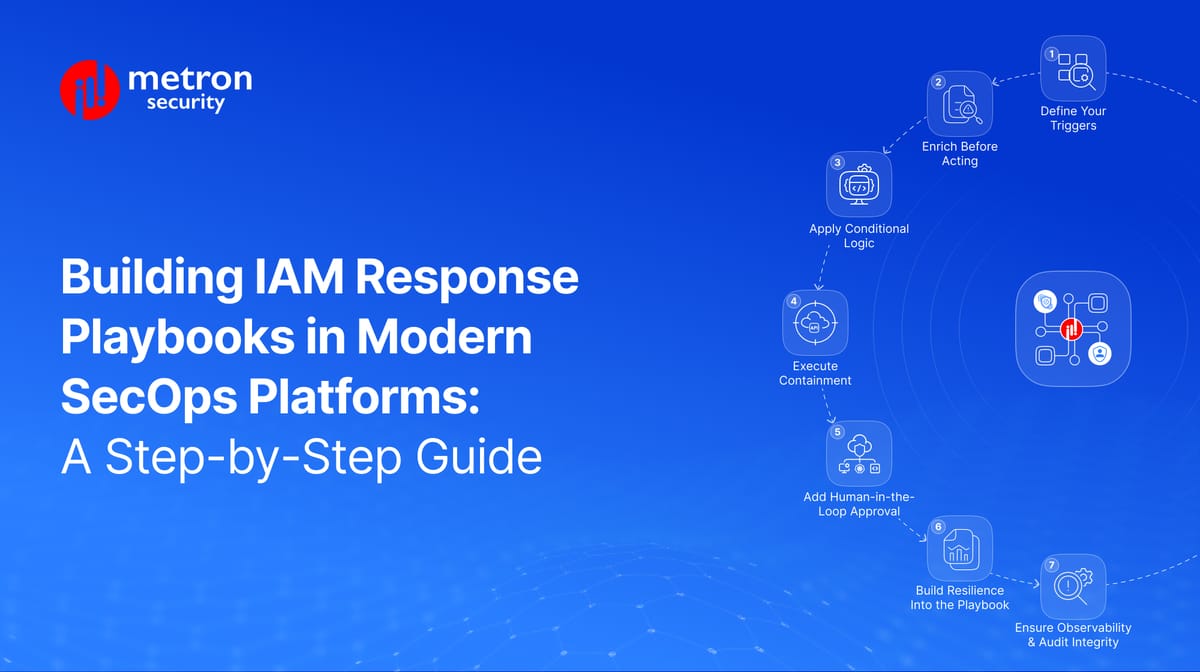
These days, security teams have strong visibility into identity risks through platforms like Microsoft Entra ID Protection, Okta Identity Threat Protection, and identity audit logs. These systems can detect suspicious sign-ins, privilege changes, and risky user behavior with increasing accuracy.
But detection is only one part of the problem teams continue to face.
The real challenge is turning those signals into structured, repeatable response workflows without relying on manual triage or untested automation.
This is where playbooks come in.
While standalone SOAR tools are increasingly being absorbed into broader SecOps platforms and “agentic SOC” models, the underlying concept of playbooks remains central. These workflows are what connect detection, enrichment, decision-making, and response into a controlled, auditable process.
A well-designed IAM playbook ensures that identity risks are handled consistently, with the right balance of automation and governance.
This guide walks through how to build such a playbook in practical terms, covering what should trigger it, how context is gathered, where decisions are made, and how actions are executed safely.
Let’s jump right in.
IAM Playbook Architecture: At a Glance
At a high level, an IAM playbook follows a simple but structured flow:
Trigger → Enrich → Decide → Contain → Approve (if required) → Log → Resolve
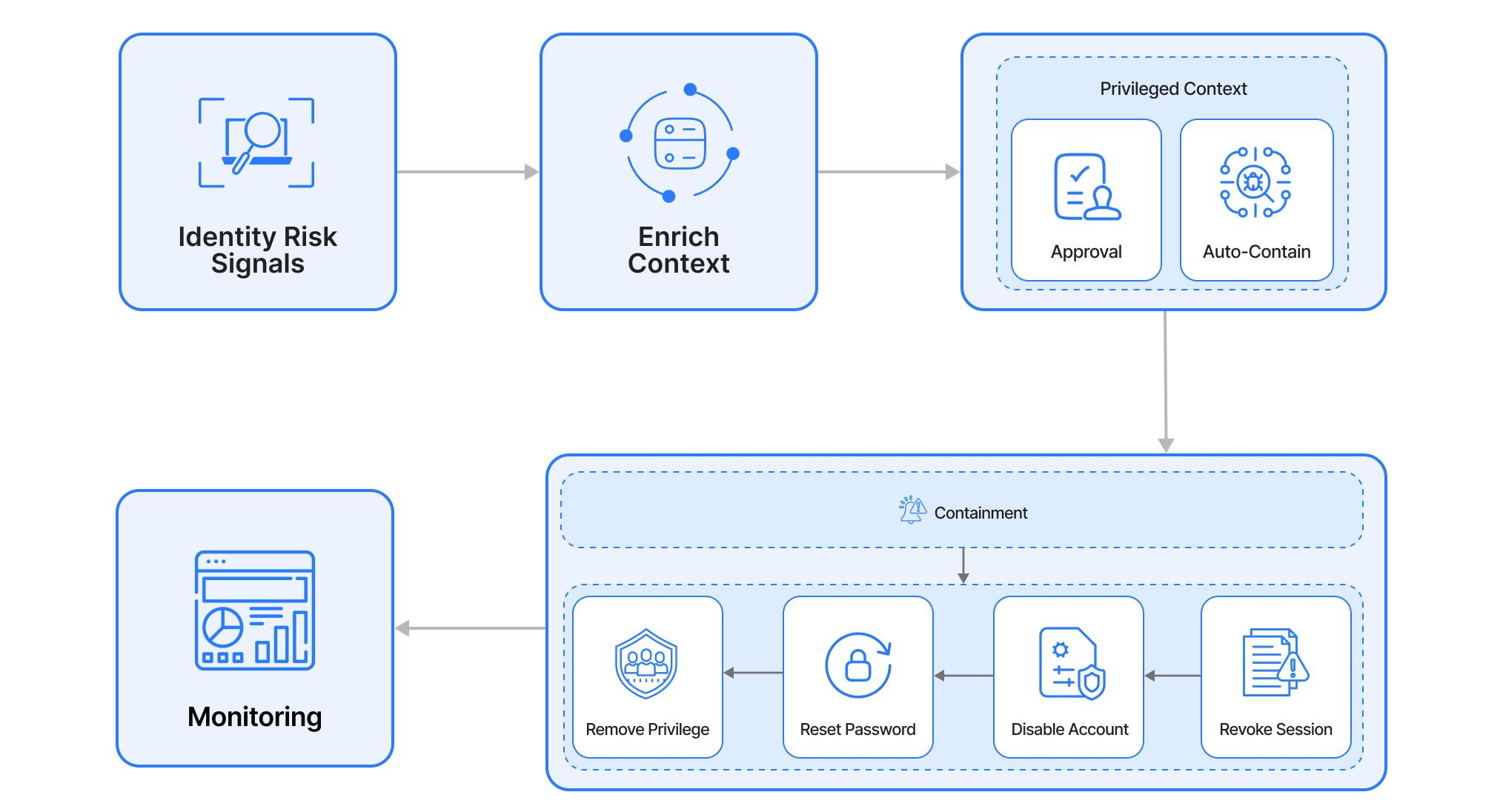
The workflow begins when a risk or privilege event is detected. It then gathers context about the user, role, and session. Based on this context, the playbook determines the appropriate response, whether that is automated containment, human approval, or monitoring.
This model is consistent across modern SecOps platforms, even if the underlying tooling differs.
With this structure in mind, the first step is defining what should activate the playbook.
Step 1: Define Your Triggers
Every IAM playbook starts with clearly defined triggers. These should represent events that genuinely require investigation or response, not every identity activity in the environment.
The most common triggers come from real-time identity risk signals like travel, anomalous token usage, suspicious MFA activity, sign-ins from threat intelligence-flagged locations, and more.
In addition, privilege-related events should also trigger playbooks, as they directly impact access risk. These include:
- assignment of global or privileged roles
- changes to privileged groups
- directory or role configuration updates
Finally, scheduled checks can identify risks that accumulate over time. These include orphaned users, unnecessary privileged accounts, or disabled users with active sessions.
Once the right triggers are defined, the next step is ensuring the playbook does not act without context.
Step 2: Enrich Before Acting
Acting on identity signals without context can lead to incorrect or overly aggressive responses.
Before taking any action, the playbook should gather relevant information about the user and the event. This typically includes:
- user profile and role information
- privilege level
- recent sign-in activity
- active sessions
- group memberships
- risk score or classification
This enrichment step allows the playbook to understand the situation before deciding how to respond.
For example, a suspicious login for a standard user may justify immediate session revocation. The same event for a global administrator may require approval before any action is taken.
Once sufficient context is gathered, the playbook can move into decision-making.
Step 3: Apply Conditional Logic
IAM response workflows must be gated intelligently. Not every event should trigger the same action.
A practical approach is to base decisions on both risk level and privilege level:
- High-risk events involving privileged users typically require approval
- High-risk events involving standard users can often be handled automatically
- Medium-risk events may require notification and monitoring
- Low-risk events can be logged or reviewed without immediate action
This approach ensures that automation is used where it is safe, while human oversight is retained where the impact is higher.
Once the decision path is defined, the playbook can execute the appropriate response.
Step 4: Execute Containment Through Identity Provider APIs
Containment actions such as disabling or suspending users, revoking active sessions, resetting credentials, or removing privileged roles should always be executed through official identity provider APIs to ensure reliability, consistency, and auditability.
The reason is that these actions form the enforcement layer of the playbook.
A well-designed flow ensures that actions are only executed after validation and that every step is recorded.
However, not all actions should be fully automated, which is where approvals become necessary.
Step 5: Add Human-in-the-Loop Approval
Automation improves speed, but governance ensures safety.
Human approval is particularly important for privileged accounts, executive users, and high-impact actions that may disrupt access
In these cases, the playbook should pause, notify the appropriate team, and wait for validation before proceeding.
If approved, containment actions are executed. If not, the incident can be escalated for manual handling. This approach ensures that the system remains both efficient and controlled.
The next step is ensuring the workflow can handle real-world conditions.
Step 6: Build Resilience Into the Playbook
IAM playbooks rely heavily on APIs, and API interactions are not always predictable. Failures can occur due to rate limits, permission issues, network interruptions, or incomplete data.
To handle this, the playbook should be designed with resilience in mind.
This includes:
- retrying temporary failures
- handling repeated actions safely
- logging responses for visibility
- escalating when actions cannot be completed
Without these safeguards, automation can fail silently, creating gaps in response.
A resilient playbook ensures that failures are visible and manageable, rather than hidden.
Step 7: Ensure Observability and Audit Integrity
Every action taken by the playbook should be traceable. Hence, it should log all the trigger events, enrichment data, timestamps, decision logics, and actions executed
In addition, the playbook should create or update tickets and maintain a clear evidence trail.
This is critical not just for operational visibility, but also for compliance and post-incident analysis.
Conclusion
IAM playbooks transform identity security from isolated detections into structured response workflows.
The real value lies in how these workflows connect each step of the process like detecting risk, gathering context, making informed decisions, executing containment, and maintaining full audit visibility.
As SecOps platforms evolve and “agentic SOC” models become more common, the underlying need for structured workflows does not change. Playbooks remain the mechanism through which decisions are enforced safely and consistently.
The goal is not to automate everything, but to automate the right things using context, control, and governance to ensure that identity risks are handled quickly without introducing new operational risk.
Designing IAM automation workflows? Metron helps security teams automate identity containment and response workflows without sacrificing governance. From building to productionizing identity playbooks aligned to your environment, our team can help. Reach out at connect@metronlabs.com