Building Custom Security Applications with CrowdStrike Falcon Foundry
Discover how Falcon Foundry applications connect CrowdStrike to your security stack.
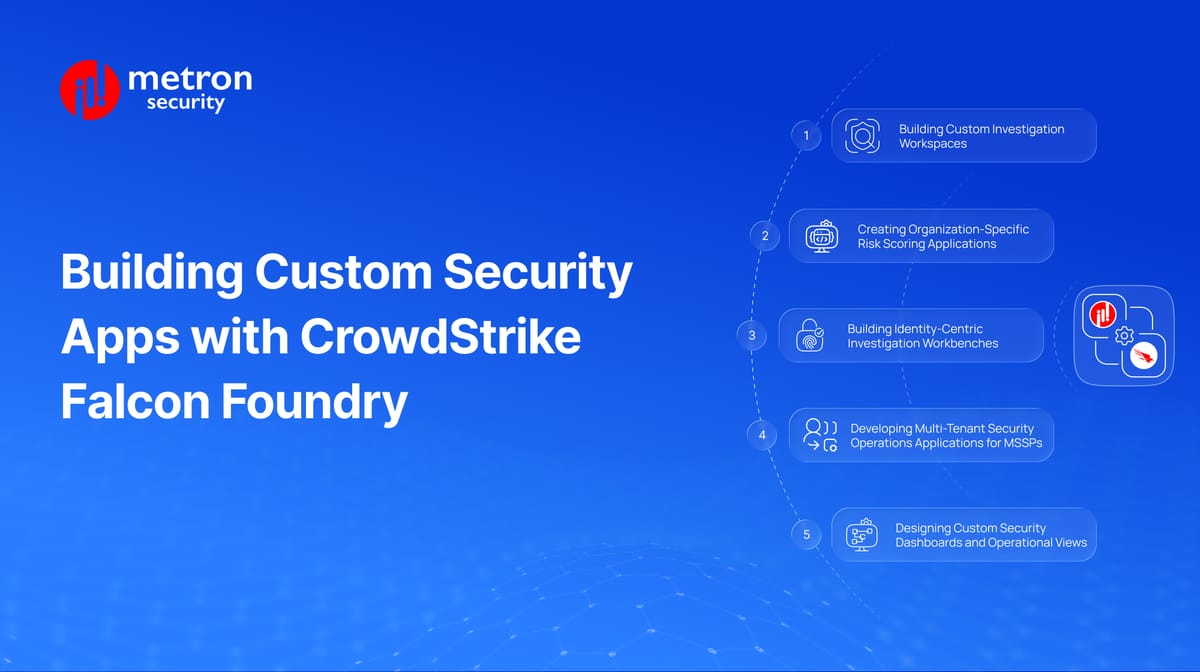
SOC Teams often need custom integrations, automated workflows, and context-specific tooling that off-the-shelf products do not cover. Building these independently means managing separate infrastructure, maintaining custom codebases, and keeping everything in sync with the core security stack.
CrowdStrike Falcon Foundry gives security engineers the ability to build custom Applications, UI extensions, Security automations, and API integrations without managing separate infrastructure or reinventing existing security data pipelines. Every app built on Foundry can be published to the CrowdStrike Marketplace, making it discoverable and installable by thousands of CrowdStrike customers globally.
Below are the prerequisites for app development, along with some of the most impactful use cases currently being built and published on the Foundry Marketplace.
Pre-requisites for Building an App on Falcon Foundry
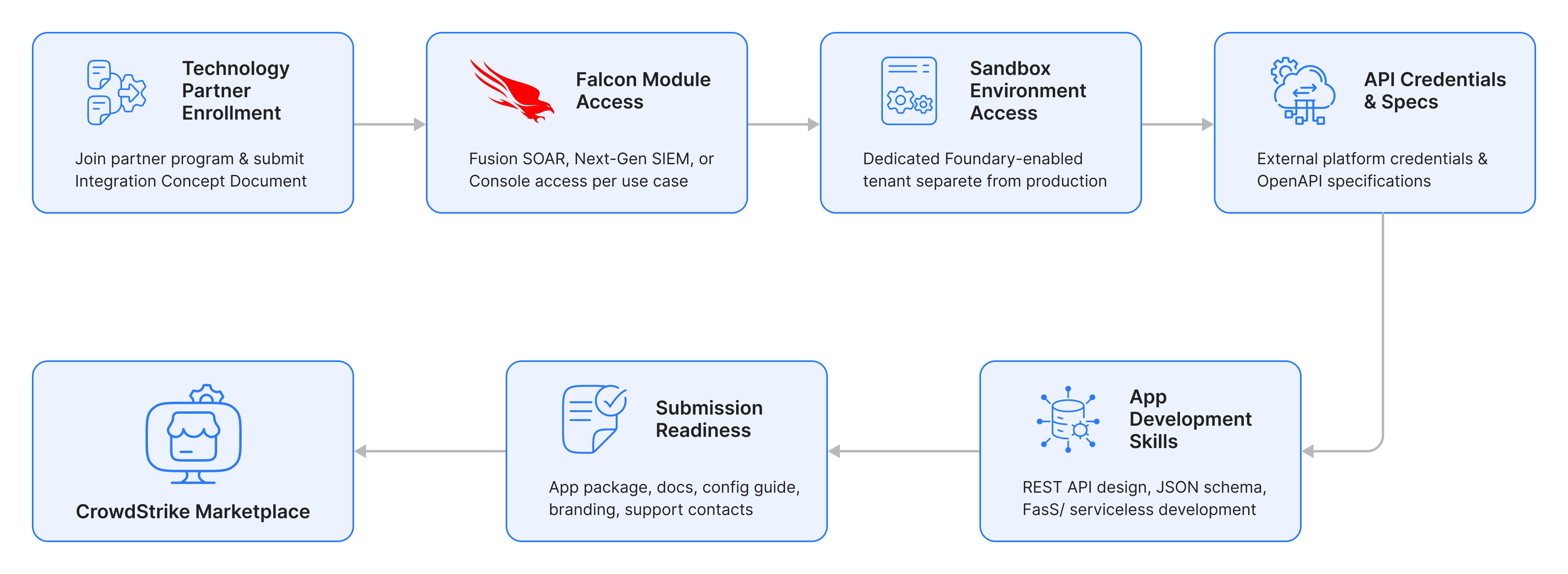
Before building a Marketplace app, the following need to be in place:
1) Technology Partner Enrollment: Joining the CrowdStrike Technology Partner Program and submitting an Integration Concept Document (ICD) that describes the app's use case, APIs consumed, and customer experience.
2) Falcon Module Access: Modules required depend on the use case. Fusion SOAR for playbook applications, Next-Gen SIEM for TI ingestion, and relevant console access for UI extensions.
3) Sandbox Environment Access: A dedicated Foundry-enabled CrowdStrike tenant separate from production for building and validating the app.
4) API Credentials and Specs: External platform API credentials and OpenAPI specifications for any third-party integrations.
5) App Development Skills: REST API design, JSON schema definition, and FaaS/serverless development experience for handling complex logic.
6) Submission Readiness: Packaged app, action documentation, customer configuration guide, branding assets, and designated support contacts are ready before the marketplace review.
With the right prerequisites in place, teams are ready to build a Foundry app. The next step is understanding where it adds value and how it helps solve common security workflow challenges.
Why Use CrowdStrike Falcon Foundry for Custom Security App Development
Building on Foundry means your Applications run inside Falcon, on CrowdStrike's infrastructure, with direct access to the platform's data and response capabilities.
Here are some of the most impactful use cases organizations can build with Falcon Foundry.
1) Building Custom Investigation Workspaces
Problem: SOC analysts often need to correlate Falcon detections with asset ownership, threat intelligence, identity information, and historical incidents stored across multiple systems. Switching between tools increases investigation complexity and can lead to inconsistent triage processes.
Solution: Organizations can build custom investigation workspaces within Falcon that consolidate relevant context from security, IT, and business systems into a single view. Using Foundry's
UI Extensions, teams can surface additional context alongside Falcon detections, while API Integrations retrieve information from CMDBs, threat intelligence platforms, ticketing systems, and identity providers. Collections can store and organize investigation data, allowing SOC analysts to access organization-specific context and historical information from a single workspace tailored to their operational requirements.
2) Creating Organization-Specific Risk Scoring Applications
Problem: SOC Teams often rely on standardized severity ratings that fail to account for business context, asset criticality, threat exposure, and organizational priorities. As a result, SOC analysts spend significant time manually determining which findings require immediate attention.
Solution: Custom risk-scoring applications built on Foundry combine Falcon telemetry with data from CMDBs, vulnerability management platforms, threat intelligence sources, and business systems. Collections can store enriched risk data, while custom logic processes multiple risk factors to generate organization-specific scores. Dashboard Builder can then present prioritized findings through customized security dashboards that align with the organization's risk model.
3) Building Identity-Threat Investigation Workbenches
Problem: Identity-based attacks require SOC analysts to investigate authentication events, privilege changes, user activity, and endpoint detections across multiple platforms. Correlating this information manually can slow investigations and increase the risk of overlooking critical attack indicators.
Solution: Dedicated identity threat investigation workbenches can be built within Falcon to provide SOC analysts with a consolidated view of authentication activity, privilege changes, user behavior, and related endpoint detections. UI Extensions to surface identity-related context directly alongside detections, while API Integrations pull data from identity providers and access management systems. Collections help organize investigation data and historical user activity, while dashboards provide visibility into identity risk trends and suspicious behaviors.
4) Developing Multi-Tenant Security Operations Applications for MSSPs
Problem: MSSPs often manage multiple customers with different operational requirements, escalation procedures, reporting expectations, and response workflows. Maintaining separate processes for each customer can create operational overhead and reduce efficiency.
Solution: MSSPs can build multi-tenant security operations applications tailored to their service delivery model, allowing customer-specific workflows, reporting, and operational processes to be managed from a centralized Falcon experience. Collections securely organizing customer-specific data, while custom workflows automate tenant-specific operational processes. Dashboard Builder provides customer-focused reporting and visibility, and UI Extensions enable SOC analysts to access tenant-specific context and actions from a centralized operational experience within Falcon.
5) Designing Custom Security Dashboards and Operational Views
Problem: Different teams need different visibility into Falcon data. SOC managers, threat hunters, vulnerability teams, and executives often require tailored views that are not available through standard dashboards.
Solution: Custom security dashboards and operational views can be created to provide different teams with the visibility they need into security operations. Using Falcon Foundry's Dashboard Builder, Collections, and API Integrations, organizations can create role-specific dashboards that combine Falcon telemetry with business and security data, providing tailored visibility into security posture, incident trends, and operational metrics.
Conclusion
At Metron Security, we help organizations and technology partners design, develop, and publish custom CrowdStrike Falcon Foundry applications. Whether you're extending Falcon, building Marketplace apps, or integrating third-party security platforms, our engineering team can help accelerate development while following CrowdStrike's best practices.
Planning to build a CrowdStrike Falcon Foundry app?
Whether you're developing Marketplace applications, automating security workflows, or extending Falcon with custom integrations, Metron Security's engineering team can help you accelerate development and successfully publish your solution.
Metron Security is a trusted CrowdStrike development partner. Reach out to us at connect@metronlabs.com.