What Is ServiceNow Domain Separation and When Should You Use It?
A deep dive into ServiceNow Domain Separation.
If you're managing security operations across multiple clients from a single ServiceNow instance, you've likely hit the wall. You know, the one where incidents start appearing across accounts, workflows trigger where they shouldn’t, and clients ask for data segregation guarantees you can’t confidently enforce.
Fortunately, that’s the problem Domain Separation is built to solve.
Domain Separation is ServiceNow’s way of creating isolated tenant environments within a single instance. After all, most ServiceNow Domain Separation projects fail for the same reason: they rely on integrations that weren’t designed for multi-tenancy.
However, this approach comes with real tradeoffs that most guides won’t tell you upfront.
In this deep dive, we cover how Domain Separation actually works, where it breaks in practice, and how to decide whether it’s the right architecture for your environment.
How Domain Separation Actually Works?
At a high level, Domain Separation enforces isolation at the data level. Here’s how that actually works.
- Domain Hierarchy
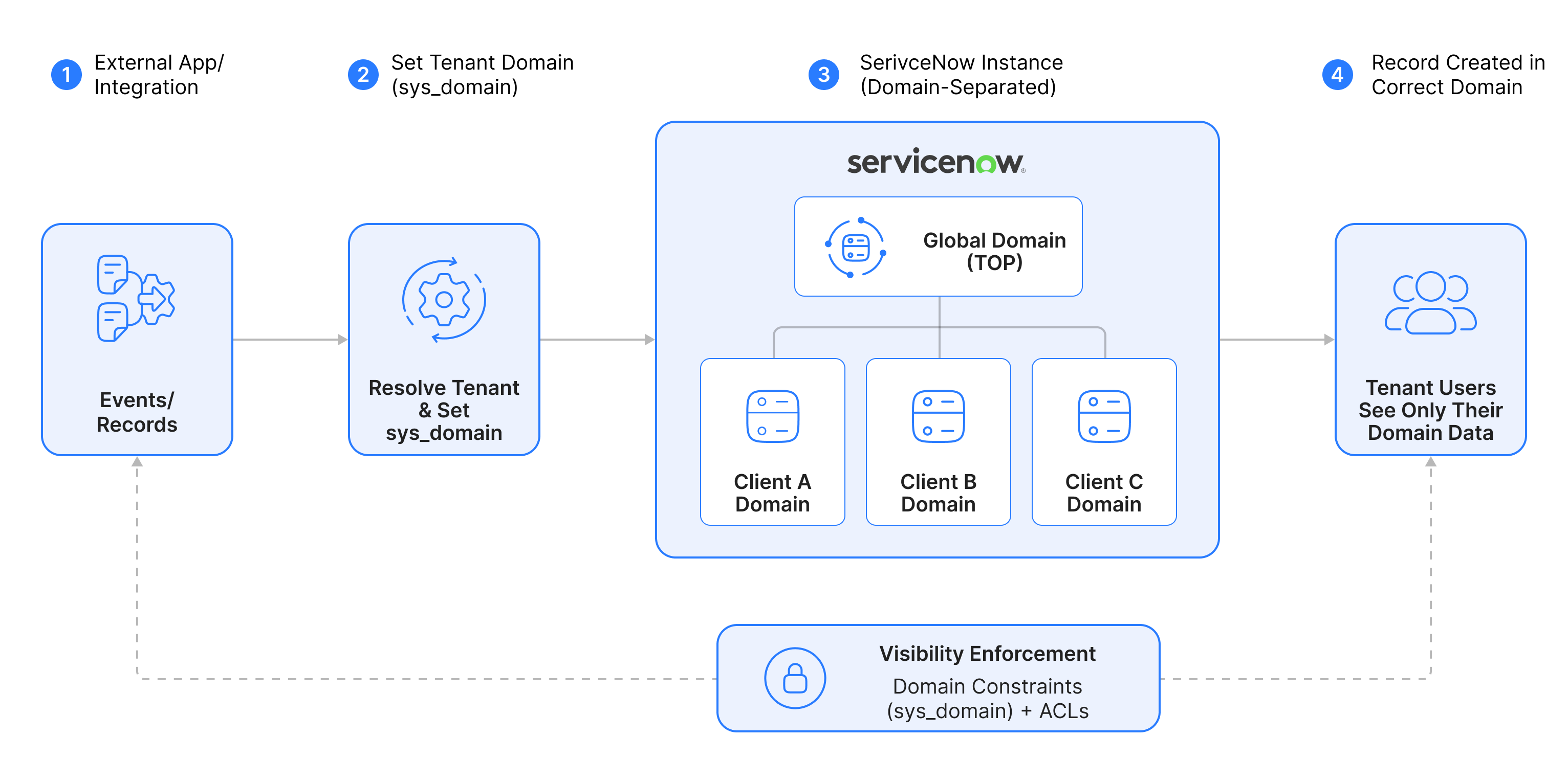
Domains are organized in a parent-child hierarchy. At the top sits the global domain, which contains everything. Below it, you create tenant or business-unit domains. Child domains can inherit configuration from parents, but records and visibility are scoped downward. A record in one domain is never visible to another, even if they share the same parent.
- The sys_domain Field
Tables in ServiceNow have a Domain (sys_domain) field, which determines which domain a record belongs to. When a user or process queries a table, ServiceNow automatically applies domain constraints. In practice, this means you only see records whose sys_domain matches your domain or falls within your domain path. This filtering happens at the query level, on every request.
- Domain Path and Inheritance
Each domain has a domain path, a dotted notation representing its position in the hierarchy (for example, TOP.ClientA). Domain visibility rules use this path to determine what a user can access. Global admins sit at the top and see everything. Domain admins are scoped to their subtree and only see their records.
- Visibility Enforcement
Enforcement is a combination of ACLs and domain constraints. ACLs control what you can do with a record. Domain constraints control whether you can see it at all.
Both layers have to be correctly configured. In a domain-separated instance, a misconfigured ACL is harder to debug because visibility is no longer just permission-based; it also depends on domain context.
The MSSP Use Case: Why This Matters
The strongest case for Domain Separation is the MSSP model: one ServiceNow instance, multiple client organizations, each expecting full operational isolation.
Without Domain Separation, everything lives in the same undifferentiated space. Incidents, workflows, and configurations are shared across clients. You can put operational controls in place to prevent cross-client access, but those controls aren’t structural. Rather, they’re procedural, and they break under pressure.
In practice, the difference looks like this:
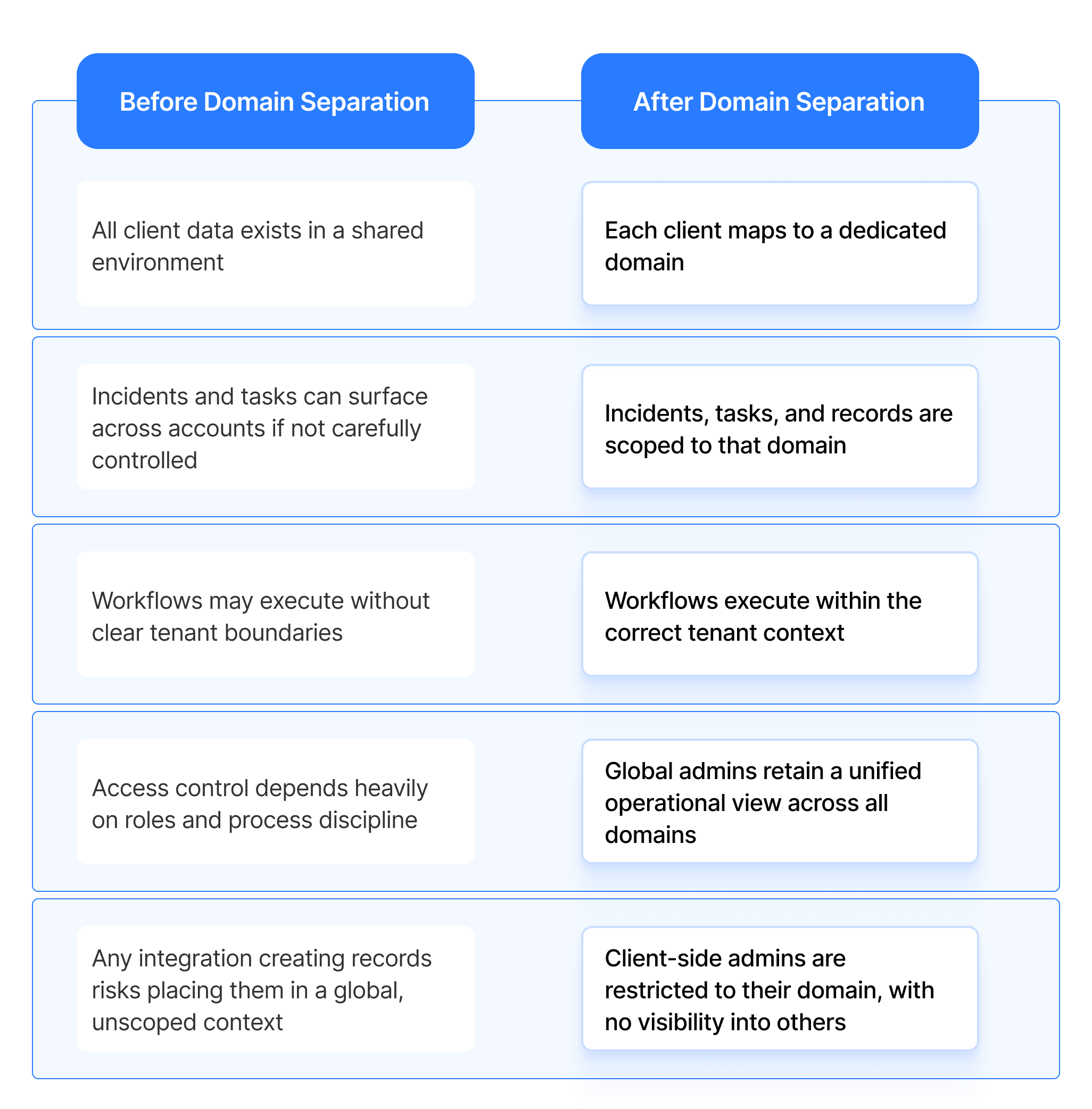
For a SASE app integration, this structure becomes critical. Each tenant operates within its own isolated environment, so events generated from the SASE application must be routed with the correct domain context explicitly defined. Without this, incidents triggered by a global integration process default to the global domain instead of being mapped to the appropriate tenant environment.
This is one of the most common real-world failures.
Integration Considerations and Tradeoffs: Where Domain Separation Breaks
Domain Separation is powerful, but it adds complexity, especially when integrations are involved.
Most out-of-the-box integrations and inbound API calls do not set domain context by default. If a MID Server or REST integration creates records without explicitly setting sys_domain, those records may land in the global domain.
This can make them invisible to the tenant admin who needs to act on them.
In practice, every integration that creates or updates records must be domain-aware. It should resolve the tenant at ingestion time, set the correct sys_domain, and route records into the right domain before workflows are triggered.
This also affects how the broader architecture is managed:
- Credentials: Shared API credentials across tenants can create risk. Credential handling should be isolated where needed.
- MID Servers: If tenants require network isolation, MID Servers may need to be mapped or scoped appropriately.
- Reporting: Domain-scoped reports only show that domain’s data. Cross-tenant dashboards require deliberate design and elevated context.
- Debugging: Issues can come from ACLs, domain constraints, workflow context, or incorrect record domains, making troubleshooting harder.
- Maintenance: Upgrades and customizations must be tested for both functionality and domain isolation.
So the real question is not just whether Domain Separation solves your isolation problem. It is whether your integrations, credentials, reporting, and support model are ready for the added complexity.
When to Use It?
Use Domain Separation when:
- You’re an MSP managing multiple clients from a single instance and need structural, not procedural, isolation
- Clients have contractual or compliance requirements for data segregation
- You need per-tenant workflows, SLAs, and automation paths
- Your team understands ServiceNow ACLs and can manage the added complexity
Conclusion
Domain Separation requires a certain architectural commitment because if done poorly, it can lead to long-term operational debt. The difference almost always comes down to planning.
Map your domain hierarchy before you touch configuration. Define your domain model end-to-end, including records, workflows, and integrations. Build domain-awareness into every integration from day one.
If you're evaluating Domain Separation for your ServiceNow environment or planning a multi-tenant MSSP architecture, let’s connect connect@metronlabs.com