Why MCP Servers Are the New Integration Surface for AI Agents
Learn what risks MCP servers introduce and how to protect them.
Vaibhavi Kadam
AI agents are moving from simple chat-based assistance to action-oriented workflows across enterprise systems. They are being used to investigate alerts, update tickets, query databases, retrieve customer records, trigger automations, and support operational decisions.
MCP, or Model Context Protocol, is an open standard that lets AI applications connect with external tools, data sources, and workflows through a common interface.
For teams already experimenting with agents, MCP is quickly becoming more than a developer convenience. It is becoming the integration layer that determines how agents discover tools, access context, and take action across business-critical systems.
That shift matters because every enterprise AI initiative eventually runs into the same question: how should agents connect securely and reliably with the systems where work actually happens?
The answer is increasingly Model Context Protocol (MCP) servers.
Let’s take a closer look at why.
Why is MCP Currently Emerging?
The rise of MCP is not happenstance. It is happening because AI agents are creating a new integration problem.
Traditional integrations usually connect one system to another. For example, when a ticket is created in a security platform, a workflow might automatically open a corresponding issue in Jira, ServiceNow, or another system of record.
AI agents are different. They do not simply move data from point A to point B. They may need to reason across multiple systems, decide which tool to use, retrieve the right context, and determine whether an action should be taken.
That makes the integration layer more dynamic.
MCP gives enterprises a more scalable integration model for this new world. Instead of building one-off agent connectors for every system, teams can expose tools and context through MCP servers that different agents can reuse.
This is why MCP is becoming an important part of the agent ecosystem. It gives developers, platform teams, and product companies a standard way to make systems agent-accessible without rebuilding the same integration logic again and again.
MCP Servers are Becoming the API Layer for Agents
Where APIs were designed for software-to-software communication, MCP servers are designed for agent-to-tool communication.
That distinction is important.
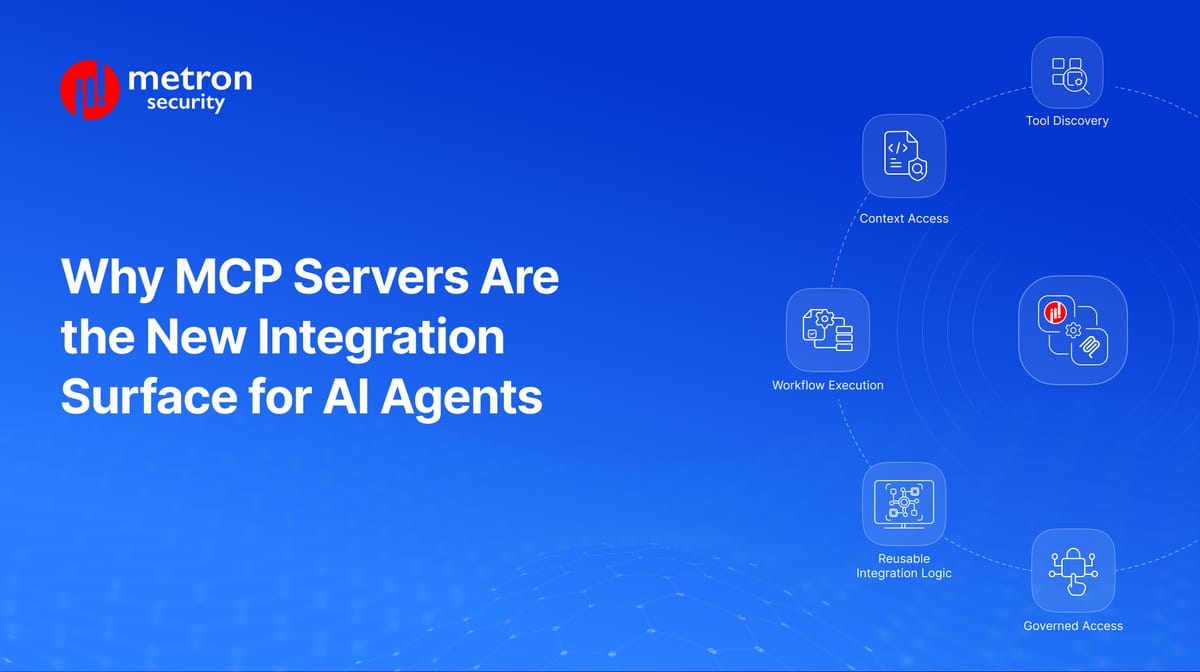
An API gives access to an endpoint while an MCP server gives an agent a structured way to understand what capabilities are available, what context can be retrieved, and which actions can be performed.
This makes MCP servers useful for:
1. Tool Discovery
Agents can identify available tools without every capability being manually embedded into the agent itself.
2. Context Access
MCP servers can expose relevant system data, documents, records, metadata, or operational context that an agent needs to complete a task.
3. Workflow Execution
Agents can trigger predefined actions such as creating a ticket, fetching asset data, checking policy status, or generating a report.
4. Reusable Integration Logic
Instead of rebuilding integrations for each agent or workflow, teams can build MCP servers once and reuse them across agentic use cases.
5. Governed Access
MCP servers can act as a control point for permissions, approvals, logging, and security policies.
This is why MCP should not be viewed as just another developer protocol. It is becoming a practical enterprise integration layer.
Why Should This Matter to Enterprises?
For enterprises, the value of MCP is not only technical standardization. It is operational scalability.
As AI agents become part of IT, security, customer support, compliance, sales, and operations workflows, companies will face a familiar challenge: integration sprawl.
Without a standard integration model, every AI agent may need custom connectors, custom permissions, custom tool definitions, and custom audit logic. That quickly becomes difficult to maintain.
MCP servers help reduce that complexity.
They allow enterprises to centralize how agents access specific systems. A well-designed MCP server can define which tools are available, what data can be retrieved, which actions require approvals, and how activity is logged.
For example:
- A SOC agent could use an MCP server to fetch alerts, enrich indicators, and open incident tickets.
- An IT agent could check device posture, reset access, or retrieve user details.
- A customer support agent could summarize the account history and recommend next actions.
- A compliance agent could retrieve evidence from multiple systems and map it to control requirements.
In all these cases, MCP provides a structured interface between the agent and enterprise systems.
The Security Side of MCP
The same thing that makes MCP powerful also makes it sensitive.
MCP servers can expose tools, data, and actions to AI agents. If they are poorly designed, they can become a new attack surface. Companies should not treat MCP servers like simple plugins. They should treat them as privileged integration endpoints.
Key security considerations include:
1. Authentication and Authorization
Every MCP server should enforce strong authentication. Agents should only access tools and data they are explicitly allowed to use.
2. Least-Privilege Tool Exposure
Do not expose every available API action to an agent. Start with narrowly scoped tools aligned to specific workflows.
3. Human Approval for Sensitive Actions
Actions such as disabling accounts, changing firewall rules, deleting records, or triggering remediation should include approval gates.
4. Logging and Auditability
Every agent action through an MCP server should be logged. Enterprises need to know which agent accessed which system, what data was retrieved, and what action was performed.
5. Prompt Injection Protection
MCP servers may pass data to agents. If external or untrusted data is included, prompt injection risks must be considered.
6. Environment Isolation
MCP servers should be deployed with clear boundaries between development, testing, and production environments.
In short, MCP servers need the same discipline enterprises already apply to APIs, service accounts, and integration middleware, plus additional controls for agent behavior.
MCP and the Future of Enterprise Integration
The future of integration will not be only API-to-API. It will increasingly be agent-to-system. That changes what integration platforms need to support.
Traditional integrations focus on moving data and triggering workflows. Agentic integrations must also support reasoning, context retrieval, tool selection, and decision boundaries.
This creates a new set of requirements:
- Standardized tool exposure
- Secure context delivery
- Agent-specific permissions
- Multi-system orchestration
- Observability across agent actions
- Governance for autonomous and semi-autonomous workflows
MCP is emerging as one of the key protocols for this transition.
Just as REST APIs became a standard way for applications to expose functionality, MCP servers may become the standard way for AI agents to consume enterprise capabilities.
Conclusion
AI agents are changing how enterprises think about integration. The question is no longer just, “Does this product have an API?” What we’re seeing instead is, “Can an AI agent safely understand and act on this system?”
MCP servers are becoming a key answer. They give agents a standard way to discover tools, access context, and execute workflows. But they must be designed with security, governance, and scalability from the start.
At Metron, we see MCP as part of the next evolution of enterprise integration. Metron helps companies build secure, reusable integration surfaces that connect AI agents with real systems, real workflows, and real business constraints. For vendors building AI-enabled products, MCP servers can make platforms agent-ready. For enterprises adopting AI agents, they provide a governed path to connect agents with existing systems.
Want to build secure, scalable MCP and AI agent integrations? Contact us at connect@metronlabs.com