The PHP Vulnerability Wake-Up Call: From Detection to Verified Remediation
Learn how Metron connects security signals, asset data and remediation workflows to assess PHP exposure, coordinate fixes and verify remediation.
Critical software vulnerabilities typically initiate a race between attackers and defenders.
Attackers go on the offensive while organisations must identify affected systems, prioritise risks and apply fixes before weaknesses can be exploited. Success depends on how quickly and reliably this process works from beginning to end.
The October 2026 PHP vulnerabilities incident demonstrated worldwide consequences associated with widely shared software weaknesses. Emergency updates and precautionary shutdowns disrupted services, including public-facing government systems, even where no breach had been identified.
In many ways, this is a consequence of AI-assisted security research. This approach is expected to uncover existing vulnerabilities faster and at greater scale, including potentially severe flaws in widely deployed systems. AI, however, can also accelerate attackers’ development of exploits, shortening the time available to respond. Organisations therefore need a continuous, coordinated process for assessing exposure and verifying remediation.
These risks extend through the software supply chain, the libraries, frameworks, runtimes, container images and vendor products on which applications depend. A weakness in one shared component can affect many services, including systems whose owners may not know that the component is present.
AI can also assist defenders with advisory interpretation, affected-version extraction, dependency analysis and remediation planning. However, production execution should remain policy-controlled: recommendations must be grounded in authoritative asset data, actions require defined approval boundaries, and closure should depend on deterministic verification rather than an AI-generated summary.
The problem: disconnected signals and incomplete follow-through
Most organisations already have tools that detect vulnerabilities, monitor threats and manage IT changes. However, these tools do not always work together.
A security warning may not identify which business applications are affected. A scanner finding may not reach the responsible team promptly. A remediation ticket may close without confirmation that the vulnerable software has stopped running.
The disconnect is often architectural rather than a missing API connection. Scanners identify hosts through IP addresses or agent IDs; cloud platforms use resource identifiers; endpoint systems maintain separate device identities; and ITSM workflows depend on CMDB relationships that may be stale.
Supply chain dependencies add another layer. A vulnerable library, PHP runtime or container base image must be traced through software component inventories and build records to the applications and deployed systems that contain it.
Reliable coordination therefore requires identity resolution, schema normalisation, contextual enrichment, a solid correlation and post-action reconciliation, linking affected components to running services, business owners and remediation workflows.
Every gap in this extends exposure or delays recovery.
Metron’s role: closing the response circuit
Metron can connect existing security and IT platforms into a continuous feedback process:
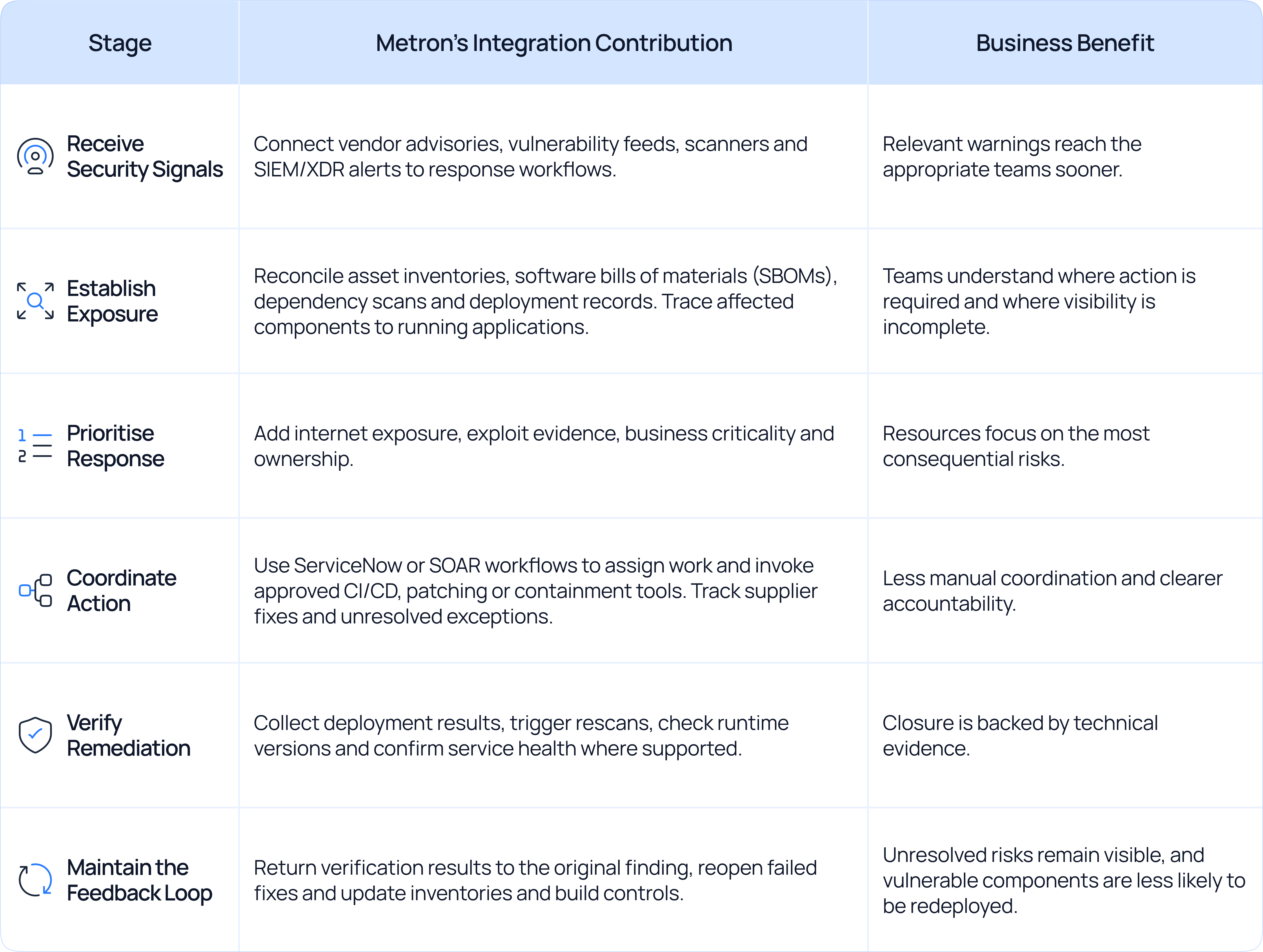
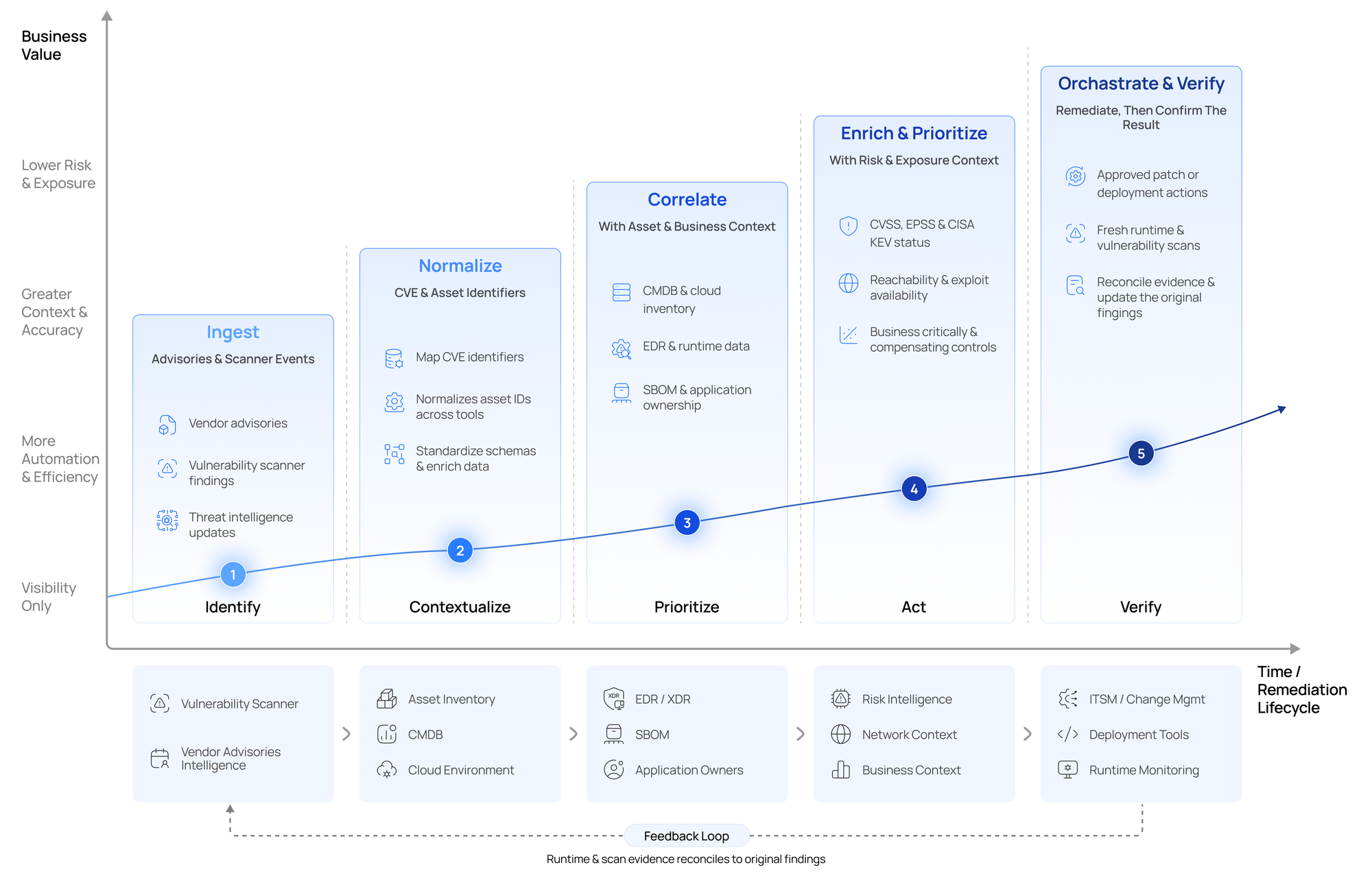
For exposure assessment, a vulnerable installed PHP package is not equivalent to a confirmed exploitable service. Correlate package and dependency versions with running processes, container images, network exposure, application dependencies and compensating controls. Where these signals are unavailable, report confidence scores and evidence gaps rather than silently marking an asset unaffected.
The circuit is complete only when evidence of remediation flows back to the original security finding.
Sending an alert or creating a ticket is an intermediate step.
For PHP, this distinction is significant: updating installed packages can leave vulnerable web-serving processes running until they are restarted or replaced.
Treat remediation as a stateful verification workflow. For the case of PHP, it is required to collect evidence that the fixed package or image is deployed, PHP-FPM or web-serving workers have restarted or been replaced, affected instances are running the intended version, and a fresh assessment no longer detects the condition. Correlate results by asset, CVE, deployment and change ID. If checks fail or are inconclusive, retain or reopen the finding and escalate the exception.
Production workflows also need idempotent actions, intelligent clients, durable correlation IDs, asynchronous job tracking, credential rotation and periodic state reconciliation. A successful API response or closed ITSM ticket confirms a workflow step and not that the vulnerable runtime has been replaced.
A foundation in proven integration expertise
This offering builds on Metron’s published work in ServiceNow Vulnerability Response, Cortex XSOAR automation, endpoint integration and security data engineering. Client-specific implementations would connect these capabilities to the organization’s existing operational processes.
Metron’s vantage point spans the engineering of integrations across hundreds of security and IT Ops platforms. The recurring challenge is not simply connecting endpoints, but reconciling inconsistent asset identifiers, schemas, authentication models and workflow semantics while preserving traceability from finding to action to evidence. Sustained engineering matters as vendors evolve APIs and platform behavior: contract testing, simulated failure scenarios, schema validation and regression testing help prevent silent breakdowns in remediation workflows.
The financial value of closing the remediation loop
The cost of a critical vulnerability extends beyond applying a security patch. Much of the effort lies in identifying affected systems, correlating findings across disconnected platforms, coordinating remediation teams, and verifying that fixes have actually eliminated the exposure.
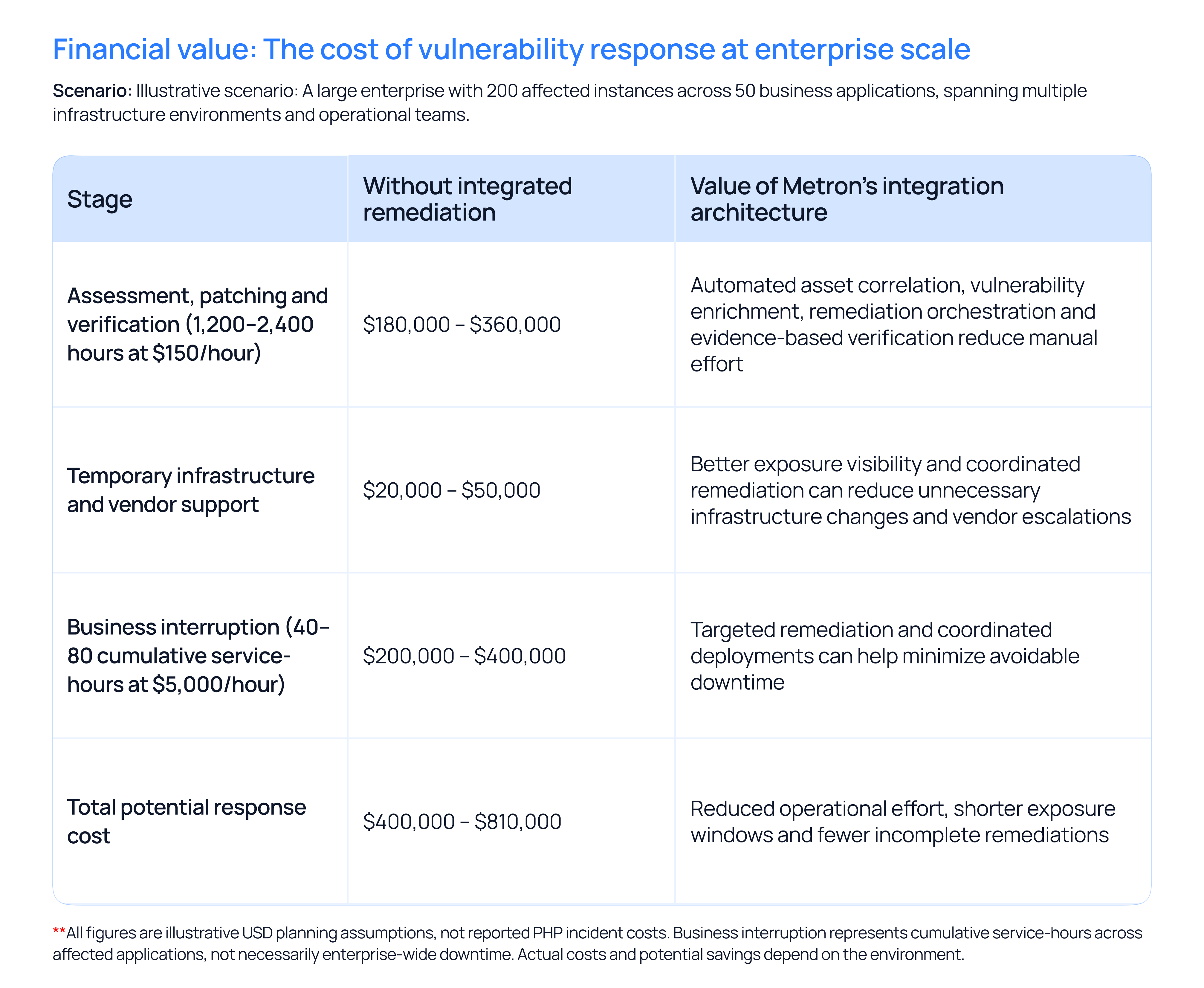
For large enterprises, the complexity of vulnerability remediation grows with the number of affected assets, business applications, infrastructure environments, and teams involved.
The financial impact is not limited to patch deployment; it includes the engineering effort required to establish exposure, coordinate remediation, validate runtime changes, and manage potential service disruptions.
Fortunately, Metron's integration architecture helps reduce this operational overhead by connecting security intelligence, asset context, remediation workflows, and technical verification into a repeatable process.
Where Metron’s engineering creates value
The opportunity is not simply to automate ticket creation, but to reduce the manual coordination and uncertainty across the entire remediation lifecycle.
- Faster exposure assessment: Correlating vulnerability intelligence with asset inventories, runtime telemetry, and application ownership reduces manual investigation.
- Reduced operational effort: Automated enrichment, prioritization, assignment, and orchestration to eliminate repetitive tasks across security and IT teams.
- Less business disruption: Better exposure context and coordinated deployment workflows can help avoid unnecessary shutdowns and prioritize affected services.
- Lower risk of incomplete remediation: Runtime verification and automated rescanning reduce the likelihood of prematurely closing unresolved vulnerabilities.
- Repeatable response at scale: Once established, the integration architecture can support future vulnerabilities without rebuilding the response process.
Metron closes the gaps between security signals, operational action and verification, helping organizations respond faster and maintain evidence that risks have been addressed.
Measuring the returns
The value can be measured through reductions in time to establish exposure, manual remediation hours, time to verified remediation, and the percentage of findings requiring rework after closure.
Ultimately, the financial benefit comes from turning fragmented, labor-intensive incident responses into repeatable, evidence-driven workflows that reduce operational costs and the duration of security exposure.
Want to know more about how this can directly impact your product or organization? Contact us at connect@metronlabs.com. Our team would be happy to assist!